
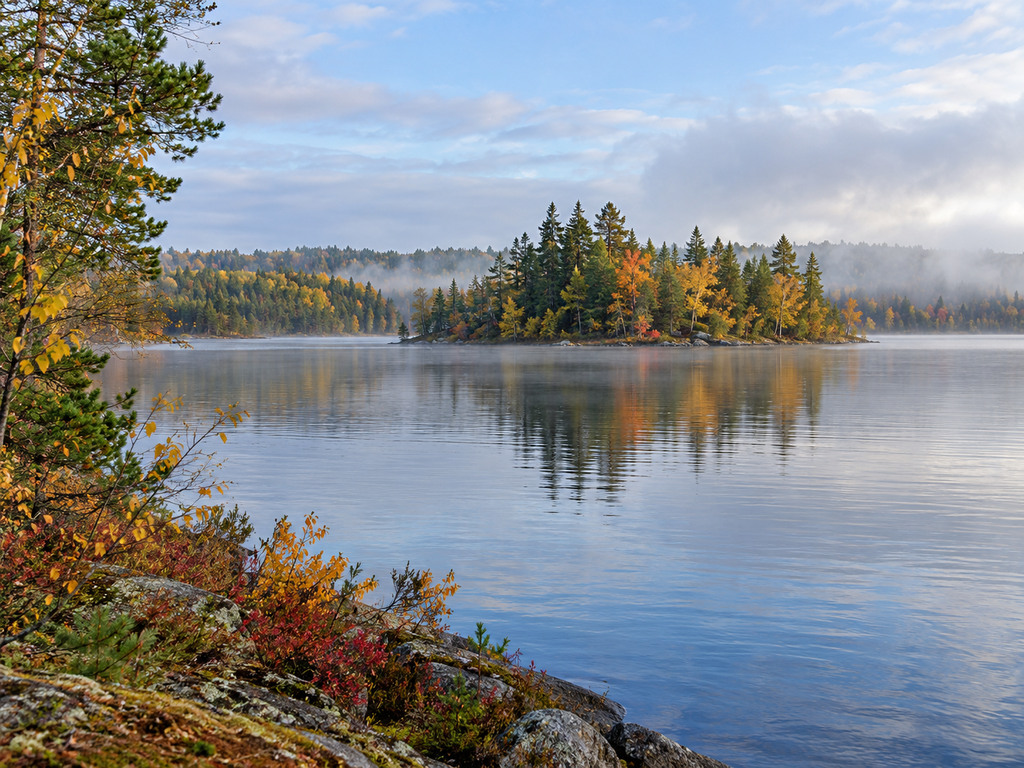
Escanaba Lake is open to public fishing, but it does not work like an ordinary Wisconsin lake. Every angler must get a free daily permit at the Escanaba Lake Check Station before fishing, follow the Northern Highland Fishery Research Area’s daily hours, and check out when the trip ends. The required stop is also useful: it is where anglers learn the current research needs, receive tagging equipment when applicable and check the remaining walleye harvest quota.

Escanaba Lake trip essentials
- Check station and launch: 9588 Nebish Lake Road, Sayner, Wisconsin 54560.
- Public access: Wisconsin DNR access record 2021 identifies a concrete-plank ramp at 46.05659648, -89.58819324.
- Permit: free and mandatory before anyone fishes any of the five research-area lakes.
- Check-out: required at the end of the fishing trip or by the end of that day’s fishing hours.
- October hours: 4 a.m. to 8 p.m. during field season; staff may close early for fieldwork and will advise anglers at check-in.
- Important tackle rule: lead tackle smaller than one ounce or one inch in any dimension is prohibited on Escanaba Lake.
Why Escanaba Lake has different rules
Escanaba is one of five experimental waters in the Northern Highland Fishery Research Area, along with Mystery, Nebish, Pallette and Spruce lakes. The program has monitored angler effort, catch and harvest since 1946. DNR describes the resulting compulsory-creel record as one of the longest continuous datasets of its kind.
The lake itself covers 293 acres and has a maintained boat launch. DNR lists walleye, muskellunge, northern pike, smallmouth bass, largemouth bass, yellow perch, bluegill, pumpkinseed and rock bass. Its long research history is the reason a simple fishing day includes a permit, a conversation with station staff and a required return visit.
Launch access, parking and accessibility
The official Wisconsin DNR Public Boat Access Sites dataset identifies Escanaba Lake Access as record 2021. It lists a concrete-plank ramp, state DNR ownership and management by the Northern Highland-American Legion recreation team. The record is active, not abandoned, and places the access at 46.05659648, -89.58819324. DNR’s current visitor page gives the street address as 9588 Nebish Lake Road, Sayner and confirms that the check station sits at the boat launch.
The statewide dataset marks the site’s ADA-accessible-feature field “No.” It does not publish parking counts, dock status, restroom details or a launch fee for this record, so those fields should not be assumed. Anglers who need a specific route, transfer surface or boarding setup should call the NHAL recreation team at (715) 385-3355, extension 119, before traveling.
How the free permit and check-out work
- Arrive at the Escanaba Lake Check Station before fishing. The station opens daily at 7 a.m.
- Get the free daily permit. A Wisconsin fishing license is also required when state licensing rules apply.
- Fishing before 7 a.m.? Use the self-registration kiosk at the check station, then check out in person after 7 a.m. the same day.
- Ask about the day’s research needs. Staff may provide a PIT-tag reader to musky anglers and may request tag numbers, fish lengths and general catch locations.
- Return before the day’s deadline. Check out when you finish or by closing time. Staff record effort and harvested fish and may ask about released catches.
Do not treat the permit as a one-time season pass. DNR describes it as a daily permit, and the check-in/check-out process is what keeps the research record accurate.
Fishing hours by month
| Month | Designated hours |
|---|---|
| January | 4 a.m.–6 p.m. |
| February | 4 a.m.–7 p.m. |
| March | 4 a.m.–8 p.m. |
| April | Ends at 8, 9 or 10 p.m., depending on ice and field season |
| May | Ends at 9 or 10 p.m., depending on ice and field season |
| June–August | 4 a.m.–10 p.m. |
| September | 4 a.m.–9 p.m. during field season |
| October | 4 a.m.–8 p.m. during field season |
| November | 4 a.m.–7 p.m. |
| December | 4 a.m.–6 p.m. |
Current Escanaba Lake fishing rules
DNR’s current Escanaba Lake rules set a special walleye season and harvest structure:
- Season: opens the second Saturday in June and closes the first Sunday in March.
- Closed period: neither recreational harvest nor catch-and-release walleye fishing is allowed between the closing and opening dates.
- Minimum length: 15 inches.
- Protected slot: walleye from 20 through 24 inches may not be harvested.
- Daily bag: three walleye, with no more than one over 24 inches.
- Quota: the station posts the remaining annual walleye harvest quota. Check it before fishing because the status can change.
DNR says all other Escanaba Lake species have no closed season, length limit or daily bag limit under the experimental lake rules. The required hours, permit, check-out and lead-tackle restriction still apply. Read the station notice and the current 2026–27 Wisconsin fishing regulations before fishing; general state licensing, methods, invasive-species and boating laws remain relevant.
Lead tackle and tagged fish
Lead tackle smaller than one ounce or one inch in any dimension is prohibited on Escanaba, Nebish and Pallette lakes. Pack non-lead alternatives before driving to the station rather than discovering the restriction at launch time.
Escanaba’s current studies also depend on anglers reporting tagged fish. DNR may issue a PIT-tag reader for muskellunge trips. If a walleye carries a visible Floy tag near the dorsal area, record the tag number, fish length and general catch location. Bring the information to the check station even when the fish is released.
Practical planning and safety
- Bring a fishing license, non-lead tackle and enough time for both check-in and check-out.
- Confirm the daily walleye quota and any fieldwork-related closing change at the station.
- Wear a properly fitted life jacket. Early-October water can be dangerously cold even on a mild afternoon.
- Use navigation lights when operating in low light and return early enough to be off the water by closing.
- Inspect the ramp and lake conditions before launching; the dataset confirms the access but does not guarantee current dock or surface condition.
- Remove plants and animals, drain all water and never move live fish before traveling to another Northwoods lake.
Nearby alternatives in the Northwoods cluster
For a conventional public-launch trip without the research-area permit process, compare three accesses in our Trout Lake launch guide. The South Twin Lake guide covers two launches, while the North Twin Lake guide compares three public options. For another focused state-managed experience, see the Black Oak Lake access guide.
Official sources
- Wisconsin DNR: Fish the Northern Highland Fishery Research Area
- Wisconsin DNR: About the Northern Highland Fishery Research Area
- Wisconsin DNR: year-round and experimental fishing waters
- Wisconsin DNR: Escanaba Lake Access dataset record (OBJECTID 1699; access ID 2021)
- Wisconsin DNR: Public Boat Access Sites dataset


Leave a Reply