
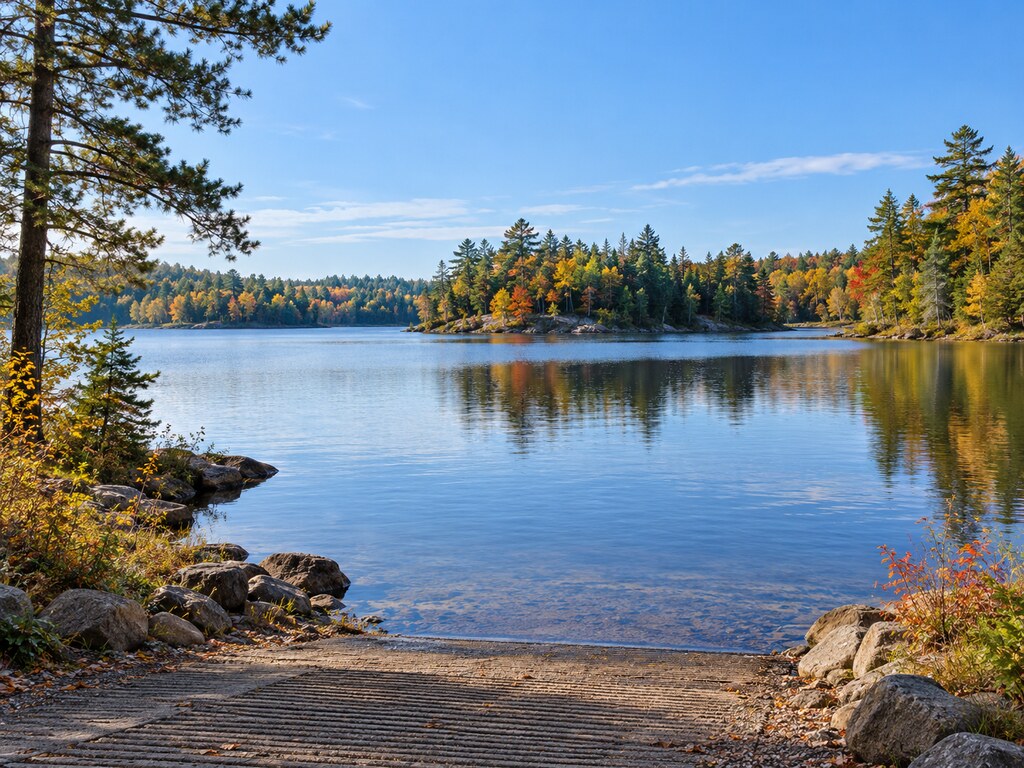
The Northern Highland–American Legion State Forest and adjoining Vilas County lake corridor offer an unusually dense choice of launch sites. Wisconsin DNR says the forest alone has more than 900 lakes and over 300 miles of rivers and streams. That abundance is useful, but it also means the practical details—ramp surface, carry-in access, motor restrictions, parking layout and special fishing rules—can vary sharply from one water to the next.

Use this planner before towing north
This hub organizes 20 detailed OutdoorsAdventures4U access guides by trip style. Start with the water that matches your boat and plans, then open the individual guide for verified landing records, restrictions, map coordinates and lake-specific links. A listing here is not a promise that every ramp suits every trailer or current water level.
Trailer-launch guides
| Guide | Best planning question |
|---|---|
| Big Muskellunge Lake boat ramps | Which of three public ramps fits the hull, depth and parking needs? |
| Clear Lake public landings | Paved ramp or quieter carry-in? |
| Muskellunge Lake boat launch | How do the accessible features and quiet hours affect the trip? |
| Boulder Lake public access | Trailer ramp or adjacent small-craft landing? |
| Oxbow Lake boat landing | What do the ramp, parking and fishing records confirm? |
| Rest Lake boat launch | How do the no-power-loading and ski-hour rules change launch timing? |
| Allequash Lake boat landing | Which access and motor rules apply? |
| Plum Lake boat landings | Parking-lot approach or street-back ramp? |
| Big Arbor Vitae Lake launches | North launch or south launch? |
| Trout Lake boat launches | North, south or campground access? |
| Black Oak Lake boat launch | What should boaters know about the paved access to a deep, clear lake? |
| Lac Vieux Desert access | Two trailer ramps or a Wisconsin River carry-in? |
| North Twin Lake launches | Millerville Lane or Lakota Road? |
| South Twin Lake launches | Twin Lake Road or the Dam Lane-area carry-in? |
| Kentuck Lake launches | West ramp or Tuttle Road? |
Carry-in and no-motor choices
Paddlers and anglers with light craft have several alternatives to a conventional trailer ramp. The Firefly Lake guide compares two carry-ins and the lake’s no-motor rule. The Crystal Lake guide covers a sand launch, seasonal planning and another no-motor setting. Clear Lake and Lac Vieux Desert also include carry-in choices alongside their trailer-access discussion.
Special-purpose trips
Three guides require extra planning beyond choosing a ramp. Escanaba Lake fishing explains the mandatory free daily permit, check-in and check-out, research-area hours, lead-tackle restriction and current experimental rules. The Allequash Lake boat-in campsites guide focuses on sites 611–614 and the logistics of reaching a campsite from the water. The Starrett Lake guide covers an electric-motor-only, slow-no-wake lake beside a designated quiet-zone campground.
Choose a launch in five steps
- Match the access type to the craft. A carry-in, sand launch and concrete trailer ramp serve different trips.
- Check the individual landing record. Look for ramp material, approach, dock, parking, accessible-feature and management details where the official source supplies them.
- Read the current water-specific fishing rules. Wisconsin DNR’s searchable regulation tool is the authority for special seasons, length limits and bag limits.
- Check current conditions. Water level, dock placement, construction and closures can change after a dataset record is published.
- Build in a second choice. The linked guides make it easy to select a nearby alternative if a ramp is crowded or unsuitable.
Fishing licenses, seasons and special rules
Wisconsin’s 2026–27 general inland fishing season opened May 2, 2026, but individual waters can have special regulations. Do not transfer a rule from one lake to another. Before fishing, use the DNR’s current fishing-regulations page and search by lake name or county. Escanaba Lake is the clearest example in this cluster of why water-specific checks matter.
Clean, drain and protect the next lake
Wisconsin requires boaters and anglers to remove attached plants and animals and drain water from boats, motors, livewells and equipment before leaving the launch area. Never move live fish away from the water. The practical routine is simple: inspect the hull and trailer, remove vegetation, drain every water-holding compartment and dispose of unwanted bait lawfully before driving to another lake.
Facilities, accessibility and safety
- Dataset accessibility fields do not replace a personal assessment of grade, boarding surface, dock height or restroom route.
- Parking counts and trailer-turning space may be absent from an official record; do not assume capacity.
- Wear a properly fitted life jacket. Fall water can be dangerously cold even when the air feels mild.
- Carry navigation lights for low-light travel and watch for local quiet hours, no-wake areas and motor restrictions.
- Use extra caution on gravel approaches and at ramps covered with wet leaves.
Official planning sources
- Wisconsin DNR: NHAL water recreation
- Wisconsin DNR: NHAL maps
- Wisconsin DNR: Public Boat Access Sites dataset
- Wisconsin DNR: 2026–27 fishing regulations
- Wisconsin DNR: boat transportation and bait laws


Leave a Reply