
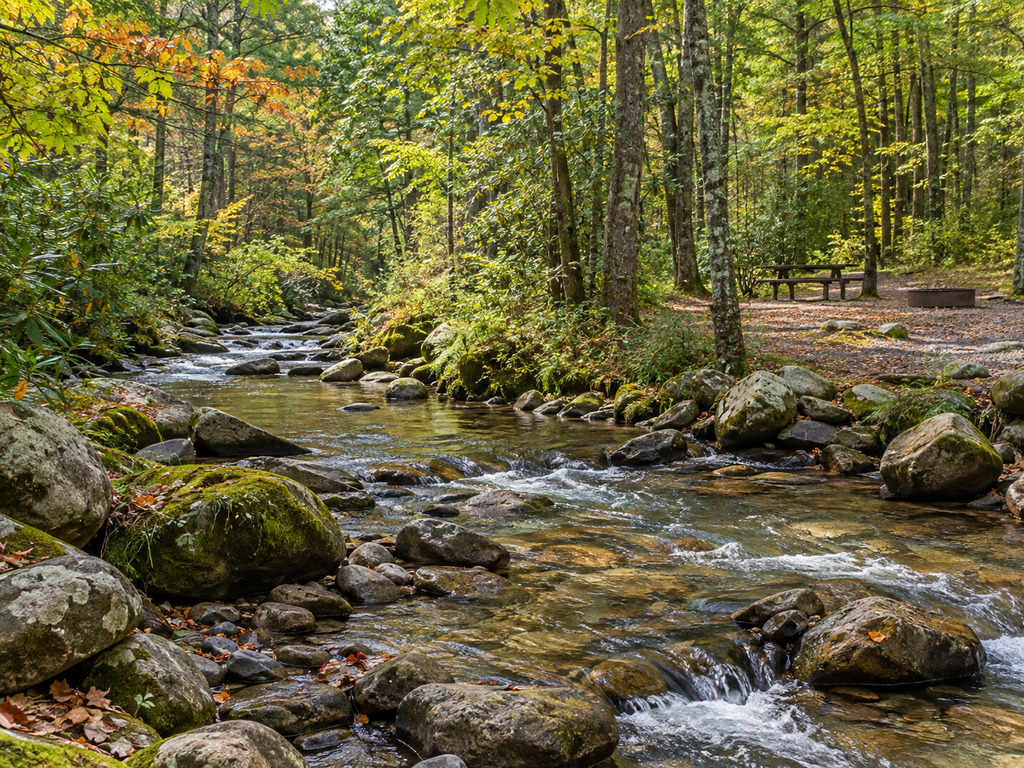

Cooper Creek combines a named North Georgia trout stream with a practical base inside the Chattahoochee-Oconee National Forest. Georgia DNR highlights the creek’s large pools and nearby camping, while the Forest Service manages the recreation area and campground facilities. That pairing makes the area useful for an overnight fishing trip—but it also means anglers should check both Georgia fishing information and federal forest conditions before driving the last mountain roads.
Why fish Cooper Creek
Cooper Creek flows through Cooper’s Creek Wildlife Management Area in Union County. Georgia DNR’s official trout-fishing directory identifies the stream as a trout destination with several large pools and places to camp. The agency’s 2026 stocking schedule places Cooper Creek in the group stocked weekly from April through July 31, then twice before Labor Day and once in fall. The weekly report dated September 25–26, 2026 recorded a September 25 stocking in Union County.
Stocking reports document agency activity, not a promise of fish at a particular pool or on a particular day. Water temperature, flow, angling pressure and weather all affect a trip. Use the reports as planning context, then fish the water in front of you and follow the current rules.
Access and the final forest-road approach
The federal recreation address is 2734 Forest Service Road 236, Suches, Georgia 30572. The Forest Service also describes approaches from Blue Ridge, Blairsville and Dahlonega. From Blue Ridge or Dahlonega, the official directions use Georgia Highway 60 and Forest Service Road 4 for the final six miles; the Blairsville approach uses Kiutuestia Creek Road, Old 76 and Mulky Gap Road.
Mountain forest roads can change after storms, flooding or maintenance. Before leaving pavement, compare your route with the current Chattahoochee-Oconee National Forest alerts. As of October 8, 2026, the forest’s active alert list did not name a Cooper Creek Recreation Area closure. Georgia DNR’s closure page directs Cooper’s Creek visitors to those federal alerts. Conditions can change after that check, so treat it as a dated verification rather than a guarantee.
Campground choices and reservations
Cooper Creek Loop and nearby Mulky Loop are presented together in the federal reservation system. The official Recreation.gov listing provides the reservable sites, current availability and operating details. Reservations cannot be made at the campground, and the campground is not a day-use parking area. If you are visiting only to fish, use a legal public access or parking location outside occupied campsites and obey posted signs.
- Sites are nonelectric and do not have utility hookups or showers.
- Vault toilets serve the campground loops.
- Drinking water is scheduled from April 1 through October 31; it is shut off for the off-peak season.
- Each campsite includes a picnic table, fire ring, gravel parking and space for no more than two vehicles unless a site listing says otherwise.
- Cell service is not available in the recreation area, so save directions, reservation details and emergency contacts before arrival.
- Pets must remain leashed, quiet hours are 10 p.m. to 6 a.m., and food must be stored securely in bear country.
The Forest Service lists the recreation area as open year-round, with seasonal services. Verify the live reservation page before assuming a particular loop, water hydrant or campsite is available.
Fishing licenses and regulations
Use Georgia DNR’s trout page and the current Georgia fishing regulations to confirm license requirements, season dates, creel limits, legal tackle and any water-specific rule before fishing. A Georgia fishing license and trout privileges are generally required unless an exemption applies. Do not rely on a stocking report as a regulation source.
Cooper’s Creek is also an active wildlife management area. Hunters may share roads, trails and woods during open seasons. Georgia announced that the 2026 primitive-weapons deer season begins October 10, only two days after this guide’s verification date. Check the official WMA page and current hunting regulations, wear highly visible clothing when seasons overlap, keep pets controlled, and never block gates or roads.
Facilities, accessibility and trip limits
The campground has basic forest facilities rather than a developed RV-resort setup. Recreation.gov identifies vault toilets and seasonal drinking water but no showers, hookups or dump station. The official listing does not provide enough detail to promise a fully accessible route from a specific campsite to the creek; contact the Blue Ridge Ranger District at 706-745-6928 for current site-specific accessibility information.
Georgia DNR’s accessible-trout-site directory describes Cooper Creek as having easily accessible banks and gives general directions via Cooper Creek Road and Mulky Gap Road. Bank conditions can still be uneven, wet or obstructed. Choose a stable entry, avoid trampling streamside vegetation and do not assume every pool is reachable by every visitor.
A practical Cooper Creek fishing plan
- Check the Forest Service alert page, weather and recent rainfall before starting the forest-road approach.
- Open the current Georgia trout rules and verify your license, legal tackle and harvest limits.
- If camping, reserve the correct Cooper Creek or Mulky loop site before entering the no-service area.
- Start near legal public access, then spread out along established paths instead of cutting new routes to the creek.
- Move carefully among pools, riffles and root-lined banks; rocks are slick and water can rise quickly after mountain rain.
- Store food and scented items securely, extinguish fires completely and pack out waste.
Nearby North Georgia alternatives
If you want a different access style, compare the Noontootla Creek guide for a rougher wild-trout setting, the Toccoa River delayed-harvest reach for seasonal catch-and-release rules, or the Tammen Park tailwater guide for developed access below Blue Ridge Dam. The Forest Service also points campers toward Deep Hole Campground on the Toccoa River when Cooper Creek is unavailable.
Bottom line
Cooper Creek works best as a combined fishing-and-camping destination: a stocked North Georgia trout stream, two reservable forest campground loops and several short trails in one public-land setting. Its advantages come with mountain-road, hunting-season and low-service realities. Verify the official pages, arrive with offline information and let current conditions—not an old trip report—set the plan.
Planning more time outside? Visit the Outdoor Adventures shop.


Leave a Reply